Best leather belts for men: complete UK guide 2026
Once you know what you are looking for, the challenge is finding it without wading through a crowded market of “genuine leather” imports where quality varies enormously and longevity is far from guaranteed.
Here is an honest confession: most men spend more time choosing a sandwich than choosing one of the best leather belts for men available to them. The sandwich gets eaten by lunchtime. The belt, if chosen well, gets worn every single day for years, many men wear the same quality belt daily, and a well-made full-grain belt can last 15 to 25 years with proper care. And yet there it is, crumpled at the bottom of the accessories basket in some high street shop, labelled “genuine leather,” looking perfectly reasonable right up until the moment it starts cracking after a year or two of regular use. Sound familiar? You are not alone.
The good news is that choosing a brilliant leather belt is not complicated once you understand three things: the grade of leather in the strap, the width that suits your actual wardrobe, and the correct size for your body. Get those right and you will buy one belt, wear it for the better part of two decades, and quietly wonder why you ever did it any other way. This guide covers all of it, written for a UK wardrobe in 2026.
What the leather grade actually tells you
The single biggest factor in how long a men’s leather belt lasts is not the brand name stamped on the buckle, it is the grade of leather in the strap itself. Most belts on UK high streets are labelled simply as “leather,” which tells you almost nothing useful about what you are actually buying.
Full-grain and top-grain: the grades worth paying for
Full-grain leather is the complete, unaltered top surface of the hide, left with its natural grain intact. The fibre structure is at its densest here, which is why full-grain belts can genuinely last 15 to 25 years with basic care. They also develop a patina over time, that warm, deepening quality that makes an old belt look distinguished rather than worn out.
Top-grain leather comes from the same layer but is sanded and buffed smooth to remove surface marks. It is still a solid, durable choice and looks more uniform from day one, but the sanding removes some of the strongest outer fibres, so it typically ages less dramatically than full-grain and may not last quite as long under daily belt stress.
Genuine and bonded leather: what those labels really mean
The term “genuine leather” is technically accurate and practically misleading. It usually refers to a lower layer of the hide, often heavily coated to make it look presentable. It is real leather, but it is not the strongest part of the hide, and it tends to wear poorly under the repeated bending and tension that a belt experiences every day, many genuine leather belts begin to show significant wear within a year or two of daily use, though longevity varies considerably depending on construction and care. Bonded leather goes a step further in the wrong direction: it is leather scraps and fibres pressed together with adhesive. It peels. It cracks. Avoid bonded leather entirely for any belt you intend to actually wear.
Why vegetable tanning makes full-grain even better
Tanning method matters almost as much as grade. Vegetable-tanned leather uses natural tannins from tree bark, producing a firmer, denser strap that holds its shape beautifully, develops a richer patina with age, and is generally a better long-term investment for a belt. Chrome-tanned leather is softer and more supple from day one and handles moisture better, but it tends to stretch and sag under belt tension over time and ages less distinctively. Neither method is wrong, but if you want a belt that looks better at fifteen years than it did at one, vegetable-tanned full-grain is the combination to ask for.
Best leather belts for men: dress, casual and everyday
A belt that works brilliantly with a navy suit looks completely out of place threaded through the loops of a pair of washed jeans, and vice versa. Width, finish and buckle style all contribute to whether a belt reads as formal or relaxed, so it is worth thinking about this before you buy rather than after.
The dress belt: slim, sleek and understated
Dress belts typically run 1 to 1.25 inches wide, which allows them to sit cleanly through the slimmer loops on formal trousers and suit trousers. A smooth, polished leather surface in black or dark tan is the standard finish, paired with a simple frame buckle in silver or gold tone. Avoid anything with heavy contrast stitching or a statement buckle in a formal context: the belt’s job here is to complete the outfit without drawing attention to itself.
The casual leather belt: wider, tougher, more forgiving
Casual and everyday belts typically start at 1.5 inches wide and suit jeans, chinos and relaxed trousers with larger belt loops. A slightly more textured or matte finish works well here, and a bit of character is a genuine asset rather than a flaw. This is the belt that benefits most from being full-grain vegetable-tanned: the natural marks and the developing patina tell the story of where it has been, which is exactly right for a well-worn casual piece.
When one belt needs to do everything
For most men, the reality is one or two belts that need to work across a range of occasions. A medium-width belt, somewhere between 1.25 and 1.375 inches, in full-grain leather with a simple frame buckle in a neutral tan or mid-brown is a sound stylistic choice. That combination sits comfortably in smart-casual territory while remaining relaxed enough for everyday wear, without looking awkward in either direction.
Getting the size right (and why most men get this wrong)
Belt sizing trips up a surprising number of men, largely because buying by trouser size alone does not account for how different cuts and rises actually sit on the body. A belt fastened on the last hole or the first looks awkward and wears the leather unevenly.
How to measure your waist for a belt
Use a soft tape measure and wrap it around the point where the belt will actually sit, not necessarily your natural waist. Measure after a normal exhale, keeping the tape flat and level. The standard UK rule adds approximately 2 inches to your trouser waist size: a 34-inch trouser waist typically needs a size 36 belt. For jeans or lower-rise cuts worn at the hip, measure directly at the waistband rather than relying on your trouser size, since the two measurements can differ by an inch or more.
The easiest method if you already own a belt that fits
If you have a belt that fits well, measure from the buckle pin to the hole you use most often. That number is your belt length. Buy your next belt in that size or the nearest available option, and if you fall between two sizes, opt for the larger one, since a quality leather belt can always be punched with an additional hole but cannot be lengthened. This approach is the most reliable when shopping online, where you cannot try before you buy, and it eliminates the guesswork entirely.
Buckle types: frame, plate and ratchet explained
The buckle you choose affects both the look of the belt and how it wears over time. Three types dominate the market, each with a different trade-off:
- Frame buckles: clean, traditional, and the most mechanically simple option. One frame, one prong, very little to fail. The most durable choice for both dress and everyday wear.
- Ratchet or automatic buckles: infinitely adjustable and comfortable to wear, which makes them popular for everyday use. The trade-off is that the internal mechanism has more moving parts and can wear out on cheaper hardware over time.
- Plate buckles: bold, decorative, and well suited to casual statement wear. Less durable under heavy daily use because the design prioritises aesthetics over mechanical simplicity.
For most men, a frame buckle in brushed or polished metal is the most sensible default. It works across occasions, lasts the longest, and never looks wrong.
Best leather belts for men in the UK: brands and makers worth knowing
Mainstream brands worth considering
Tommy Hilfiger, R.M. Williams and John Lewis all stock men’s leather belts at varying price points, from around £45 for branded fashion belts to £100 and above for premium options. Mass-market brands vary widely in leather grade, so it is always worth checking the product description for “full-grain” rather than accepting “leather” at face value. A higher price tag from a well-known brand does not automatically mean a better grade of leather in the strap.
British artisan belt makers
The UK has a strong tradition of small-batch leather making, and several independent makers produce genuinely excellent belts. Aldridges use full-grain bridle hide to make bespoke belts in England. Warriner Leather works with oak-bark tanned hides. Mackenzie and George use full-grain vegetable-tanned saddle hide, handmade to order. Oakside Belts craft their straps from English bridle leather in Kent. These makers offer a level of material quality and specificity that mainstream retail does not stock, and buying from them often means you can specify the leather, the finish and the hardware rather than accepting a fixed combination.
Custom-made leather belts from Two Fat Dogs
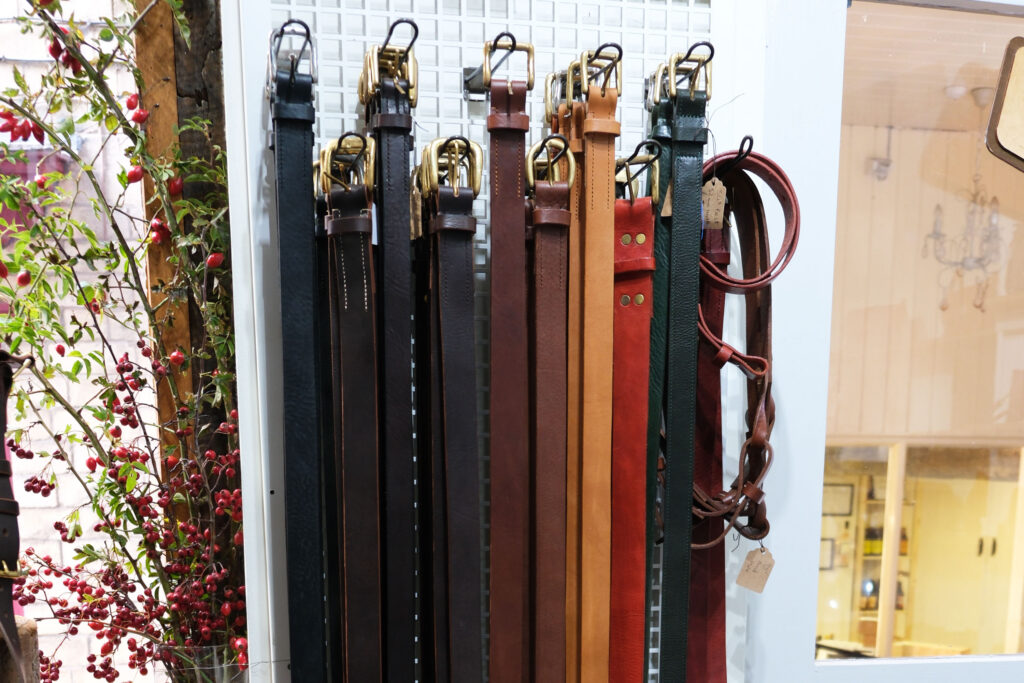
To be straightforward about it: Two Fat Dogs is where we come in, and it is worth explaining what that actually means in practice. Every belt is handcrafted in our own on-site workshop, not outsourced, not factory-produced, not assembled from components sourced elsewhere. You choose the leather grade, the colour and the hardware rather than accepting whatever combination a brand has packaged that season.
The result is a belt that fits correctly and is built from materials you have selected yourself. For a meaningful gift, a special occasion, or simply because you would rather not replace a belt every couple of years, a custom-made piece offers something that mass-market retail is not set up to provide: genuine choice over every element of the finished article. If that sounds like what you are after, we would be glad to talk it through.
A simple care routine that doubles your belt’s lifespan
A quality leather belt is an investment, and the care routine it needs is far less demanding than most people expect. A little attention every few months is genuinely all it takes.
The first few weeks: breaking in a new belt
A stiff full-grain or vegetable-tanned belt is not a sign of poor quality, it is exactly what it should feel like. The leather will soften with wear, gradually moulding to your body and your habits. Avoid forcing it to bend sharply in the early weeks. After the first week of wear, a light application of a quality leather conditioner, a beeswax-based balm or a product such as Renapur Leather Balsam, helps the fibres relax without losing the belt’s structure. Do not over-condition in the early weeks: a thin, even application is all the leather needs.
Keeping it in good shape for the long term
Day-to-day upkeep is straightforward. Wipe off surface dirt with a slightly damp cloth and allow it to dry naturally. Apply a beeswax or lanolin-based conditioner every three to six months, working it in with a soft cloth and buffing off any excess. Store the belt flat or hung rather than coiled tightly, and keep it away from direct sunlight and heat sources, which dry out the leather and accelerate cracking. One final point worth remembering: the patina that develops on a full-grain belt over time is not damage. It is the leather maturing exactly as it was designed to, and it is one of the reasons a well-made belt is genuinely worth the investment.
The short version, for the man who has read enough
Choosing from the best leather belts for men comes down to four decisions: the grade of leather (full-grain for longevity, always), the width that matches your wardrobe and your trouser loops, the correct size measured from the body rather than guessed from a trouser label, and a maker who actually stands behind their craft. Get those four things right and you will buy one belt, wear it until it develops a personality of its own, and never think about it again except to appreciate it.
If you want to find the best leather belts for men, made to your specifications from materials worth buying, get in touch with the team at Two Fat Dogs. We make every piece by hand in our own workshop, and we would be glad to help you find exactly what you are looking for.