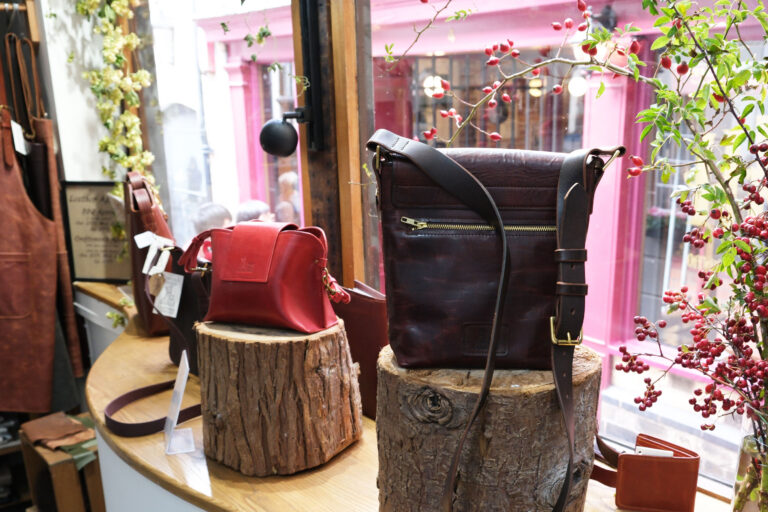
Here’s something most buyers discover too late: the word “handmade” on a leather bag label means almost nothing on its own. The stitching looks fine in the shop, the leather smells right, and the price feels serious enough to suggest quality. Then six months of daily use later, the handles start to fray at the stress points, the seams loosen, and that rich colour you fell for turns patchy rather than developing into the warm patina you were promised.
You weren’t imagining quality. You just didn’t know what to look for yet. And most brands, frankly, are not in the business of teaching you. Understanding what genuine handmade leather bags look like, feel like, and are built from is the knowledge that changes a purchase from a gamble into a confident decision.
Workshops like Two Fat Dogs handle every stage under one roof, from cutting and skiving through to edge finishing. That sets a standard most buyers don’t even know to ask about. By the end of this guide, you will. We’ll cover materials, construction, pricing, makers worth knowing, and care. Everything you need to buy well, once.
What “handmade” actually means in leather bag construction
The process from hide to finished bag
Genuine handcrafting follows a clear sequence: selecting and inspecting the hide for grain quality and markings, cutting panels by hand or with hand-operated tools, skiving the edges so overlapping pieces sit flush, assembling the panels, stitching, attaching hardware, and burnishing or finishing every edge. That sequence typically takes an artisan 20 to 40 hours per bag, depending on complexity. The reason that time matters is not romance; it’s oversight. A single maker or small team handling multiple stages catches problems as they develop, rather than passing a piece down a production line where no one person sees the whole picture.
Most “handmade” labels tell a much narrower story. In practice, that label often means one or two steps were done by hand, while cutting, lining, and panel preparation were handled by machine or outsourced entirely. That’s not dishonest in a legal sense, but it’s a long way from what the label implies.
How in-house workshop production changes the result
At Two Fat Dogs, every decision sits with the maker: the tension in the thread, the depth of the dye, the angle of the bevel on each edge. That end-to-end control produces a bag where nothing is guessed at or left to a supplier’s interpretation. Contrast that with brands that source pre-cut or pre-finished panels from overseas and complete assembly locally, which technically qualifies as handmade but bypasses the craft almost entirely.
This isn’t a criticism of every brand that uses machines. There are excellent machine-stitched bags made at scale. The point is that “handmade” without context is a marketing word, not a quality guarantee. Knowing what to ask strips that ambiguity away.
The leather itself: how material choice determines everything
Full-grain vs top-grain: what the difference means for your bag
Full-grain leather is the top layer of the hide left completely intact, natural markings and all. Because the densest surface fibres stay untouched, it’s the strongest grade available and the one most likely to develop a genuine patina over years of use. Those natural marks aren’t flaws, they’re proof that the leather has been left as nature made it, rather than sanded into something safer and more uniform.
Top-grain leather also comes from that surface layer, but the hide is sanded or buffed to remove blemishes and then coated for a clean, consistent finish. It looks more polished straight out of the box. The trade-off is durability: removing those surface fibres takes away the leather’s natural armour. For a bag you want to carry daily for the next 15 to 30 years, full-grain leather bags are the material to prioritise. For something worn occasionally and kept carefully, top-grain is a reasonable choice at a lower price point.
Why vegetable-tanned leather deserves its reputation
Tanning method and grain grade are separate classifications that stack on top of each other. Vegetable-tanned leather uses natural plant tannins rather than chromium salts, takes considerably longer to produce, and results in firmer, more structured leather that develops a deep, rich patina rather than wearing out. The process is slower and more expensive, which is why it’s associated with makers who are serious about longevity.
Vegetable-tanned leather bags earn their reputation because the material genuinely improves with age. Every scratch and crease softens and darkens into character rather than becoming damage. On the sustainability side, vegetable tanning is generally regarded as the more environmentally responsible method, and many reputable tanneries now hold Leather Working Group (LWG) certification to evidence their environmental standards, covering water use, chemical management, and waste controls. If a maker can tell you both the grain grade and the tanning method, and name the tannery, that’s a very good sign.
The craftsmanship details that tell a quality bag from a dressed-up one
Stitching: the single most revealing quality signal
Saddle stitching is the mark of a genuinely hand-stitched leather bag. Two needles work through pre-punched holes from either side, locking each stitch independently. If one thread breaks under stress, the rest of the seam holds. Machine stitching uses a single interlocking loop; once that loop breaks, the seam can unravel along its full length. That’s the practical difference, not theory.
Good saddle stitching is even, tight, and consistent in spacing, with linen or waxed polyester thread sitting flush with the leather surface rather than proud of it. Irregular spacing, thread that loops or puckers, or stitching that looks noticeably different on the reverse side are all signs that care was not taken. Check this before you buy anything, regardless of price tag or label.
Edge finishing, hardware, and the details most buyers overlook
On a well-made artisanal leather handbag, every raw edge is burnished, bevelled, or painted smooth. Raw or rough edges aren’t rustic; they’re a shortcut. Edge finishing protects the leather from moisture and wear at its most vulnerable points, exactly where a bag fails first if corners were cut during construction.
Hardware tells its own story. Solid brass or steel sits noticeably heavier in the hand than plated zinc alloy. Test every clasp, buckle, and D-ring before committing: they should move smoothly and feel substantial, not hollow or loose. The interior is the final check most buyers skip entirely. Clean lining seams, reinforced pocket corners, and tidy stitch lines inside the bag are signs of a craftsperson who cares about the parts you can’t see in a shop window photo. The interior of a quality bag is as revealing as the exterior.
What handmade leather bags typically cost in the UK
Understanding the price range and what drives it
Genuinely handmade full-grain leather bags from UK makers typically sit between £150 and £600, with entry-level artisan pieces around £95 to £175 and higher-end or bespoke options reaching £500 to £830. Those figures reflect leather grade, tanning method, time spent at each stage, hardware quality, and batch size. A maker producing ten bags a week in a small studio cannot price the same as a factory producing thousands.
A well-made bag in the £200 to £400 range from a credible UK workshop is genuinely a 20-year purchase when maintained properly. Spread across two decades of daily use, those figures look very different from a £60 high-street bag that needs replacing every two years. The principle is simple: buy one good thing, once.
Bespoke and made-to-order: when the premium is worth it
Several UK makers offer bespoke leather bags where the buyer selects hide, hardware, dimensions, and colour. Studios including Two Fat Dogs, Ottely, Harriet Warrilow, and Oskar Bespoke Bag Maker work at this level of customisation. The premium for bespoke is real, often adding 30 to 50 per cent to the base cost, but for a piece built precisely around your use and proportions, it’s frequently the most practical investment you’ll make.
Made-to-order and bespoke pieces typically carry lead times of four to twelve weeks, so factor that in if you’re buying as a gift. A good workshop worth commissioning will discuss the timeline clearly upfront and communicate throughout the process.
How to care for your bag so it lasts decades, not years
The routine that keeps leather in peak condition
Clean regularly with a soft, dry cloth to remove dust and surface grime; for anything more stubborn, a slightly damp cloth with a leather-specific cleaner handles most situations. Avoid soaking the leather or using heat to speed up drying, always let it air-dry naturally, away from radiators and direct sunlight.
Condition the leather every few months with a quality conditioner, or more frequently if you live somewhere with central heating or a dry climate. Conditioning keeps the leather supple and prevents the drying and cracking that shortens a bag’s life considerably. Store the bag in a cool, ventilated space away from direct light, stuffed lightly to hold its shape, and avoid hanging it long-term from a single strap, which can distort the structure over time.
What to do when your bag needs repair, not replacement
The most common failure points in even the best bags are hardware, seams, and straps. The leather itself, if full-grain and properly cared for, is almost always the last thing to give out. A quality handcrafted leather bag can be repaired rather than replaced in nearly every scenario: re-stitched seams, replaced straps or handles, re-lined interiors, reconditioned leather, replaced hardware.
Ask about repair services before you buy. A workshop that offers repair and stands behind the work long after the sale is one of the clearest signals that you’re buying from someone who believes in what they’ve made. That kind of relationship with your bag, knowing it can be fixed and kept going, is one of the strongest arguments for buying from an artisan workshop rather than a high-street chain.
Where to find genuine handmade leather bags in the UK
UK workshops and makers worth knowing
The UK has a genuinely strong tradition of leather bag making, and several workshops are worth your attention. Tusting is a family-owned heritage maker with multiple generations of English leather expertise behind it, producing classic pieces with an emphasis on traditional craft. The Cambridge Satchel Company has made handmade leather satchels in England since 2008, with both traditional and contemporary designs. CARV makes minimalist, vegetable-tanned crossbody bags entirely without machines, which is a genuine rarity.
For handcrafted artisanal leather handbags from an English studio, Harriet Warrilow and Two Fat Dogs each work at a small, artisan-led scale with full-grain leather. Melissa Marie Leather produces made-to-order pieces from UK tanneries, designed to age beautifully over decades. Warriner Leather uses oak-bark tanned hides from Britain’s last remaining oak bark tannery, giving its bags a distinctive character and provenance. For fully bespoke commissions, Two Fat Dogs (Shropshire), Ottely (Gloucestershire) and Oskar Bespoke Bag Maker (Edinburgh) can be handcrafted individually to specification.
Two Fat Dogs also produce small runs of leather items for one of the most famous, and expensive car makers in the UK. We can’t tell you who but they trust us to impress their customers.
What to look for when buying online or in person
Ask these questions before committing: Where is the leather sourced, and from which tannery? Is the bag made entirely in-house or assembled from pre-cut panels? What stitching method is used? What is the repair policy? A studio that answers those questions clearly and willingly is almost always one worth trusting.
If you’re buying in person, run your fingers along every edge: burnished and smooth means attention and care. Check the stitching under good light, both inside and out. Open and close every clasp and buckle. If buying online, look for detailed process photography showing the workshop, not just the finished product. A craftsperson who shows you the cutting, the stitching, the finishing stages is one who is proud of every part of the process, and that pride is exactly what you’re paying for.
Buying once and buying well
Buying a handmade leather bag isn’t about spending more for a label. It’s about understanding what goes into making something that will genuinely outlast a decade of daily use, and choosing accordingly. The signals are consistent across every good maker: full-grain or vegetable-tanned leather, hand-stitched seams, burnished edges, solid hardware, and a workshop that controls the process from hide to finished piece.
When those things come together, the result is a bag you stop thinking about replacing. You start thinking about where it’s been with you. That’s the real difference between a purchase and an investment, and it’s what genuine handmade leather bags have always been built to offer. Find the right one from the right hands, and you’ll understand immediately why it matters.